

There was a time when contour ruled everything - razor sharp cheekbones, ultra-sharpened jawlines, cool-toned shadows dragged dramatically under the face. The goal was definition, structure, and angles you could see from across the room.
And listen, sculpting isn’t going anywhere - we love a snatched moment. But something has shifted. The heavy carving has lightened, the lines are more diffused, and the overall vibe feels less rigid and more lived-in.
So what’s actually the difference between bronzer and contour? And do you need both, or have we all just been over-layering out of habit?
Let’s break it down.
Bronzer vs Contour at a Glance
Want glow and warmth? Reach for bronzer.
Want sharper structure? That’s contour.
-
Bronzer uses warm tones and diffused placement for that soft, sunlit haze.
-
Contour leans cool and precise to create depth and definition.

Why Bronzer and Contour Get Confused
Bronzer and contour are often placed in similar areas of the face — under cheekbones, around the temples, along the jaw — so it’s easy to assume they’re basically the same. But once they’re actually on your skin, the difference is clear.
Contour peaked during the full-glam Instagram era (hello 2016, IYKYK) — designed for heavy studio lighting, flash photography, and ultra-defined everything - brows, jaw, cut-crease, all the things.
Bronzer, on the other hand, is basically sunlight in makeup form. One carves, while the other warms. And on real skin, in real daylight (aka not a ring light), they hit completely differently.
What Bronzer Actually Does
Bronzer isn’t trying to create a new bone structure — it’s there to bring warmth back into the skin.
Think about what foundation does — it evens everything out, which can sometimes leave the face looking a little flat. Bronzer adds that dimension back in, but in a way that feels natural, like you’ve just been sunbathing for a bit.
A sweep across the temples, the tops of the cheekbones, maybe a touch across the bridge of the nose — it mimics where the sun would naturally hit. Because warm tones reflect light more dreamily, they tend to blur instead of deepen. That’s why bronzer usually feels more forgiving on textured skin, fine lines, and pores.
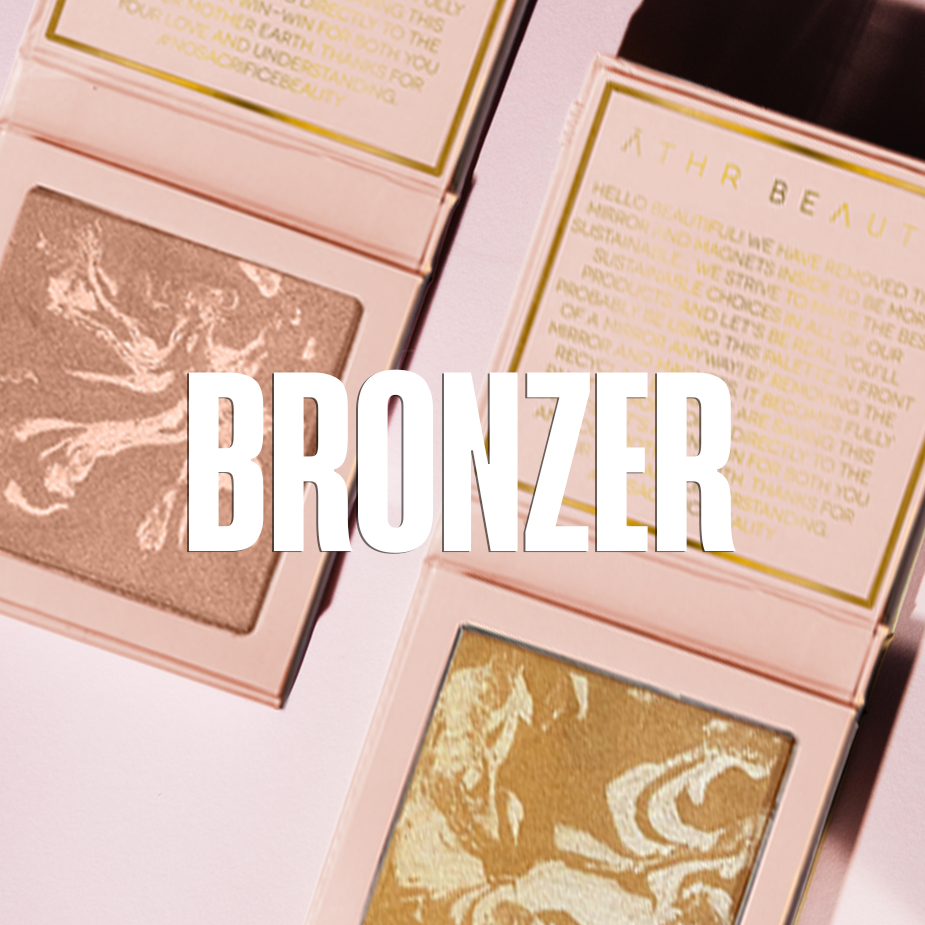
That’s also why a buildable, soft-focus formula matters. Our Diffused Reflections Bronzing Powder is designed to layer gradually, so you can warm the skin without tipping into muddy or overdone.
And if you think bronzer only belongs on your cheeks, we promise it does more than that — here are 10 ways to use your bronzer beyond your cheeks.

What Contour Actually Does (And Why It Can Be Tricky)
Contour is meant to create shadow — the kind that naturally sits beneath your cheekbones or along your jawline.
Because shadow absorbs light, contour shades are usually cool or neutral-toned and matte. Undertone matters here — if it’s too warm, it starts looking like bronzer. Too deep, and it can go from subtle to stripe real quick.
When it’s blended (and color-matched) well, contour can subtly define your features and sharpen things up a bit. It’s the move when you want a little extra structure — more snatched, Bella Hadid vibes.
The only thing is, contour doesn’t blur the way bronzer does - it deepens. So if it’s placed too low or built up too heavily, it can start to look heavier than you planned — especially in natural daylight.
Contour isn’t dramatic by default - it just needs more precise placement, some blending patience, and the right undertone.
The Science of Warm vs Cool on the Face
This is where it gets interesting — because the difference isn’t just about tone, it’s about how light interacts with your face.
Warm tones reflect light. They bounce it gently across the skin, which is why bronzer tends to look glowy, blurred, and a little more forgiving. Even if you’re wearing matte foundation, bronzer can bring that luminosity back in.
Cool tones absorb light. That absorption creates depth — which is exactly what contour is supposed to do. It adds contrast, it carves, and it sharpens.
Neither is wrong. They just create very different visual effects.
And you’ve probably seen this play out on your own face. Something looked amazing at night, then you caught yourself in the daylight and thought… oh. That’s because contour reads strongest in natural light. Warmth, on the other hand, tends to soften and lift when the sun hits it.
So when your makeup feels effortless and dimensional, you’re usually playing with reflection (bronzer). When it feels more sculpted and defined, you’re leaning into absorption (contour).

Is Contour Aging You?
Contour isn’t aging by default. But too much in the wrong spot? It can start doing things you didn’t ask for.
Because contour creates depth, it literally pushes areas back. If it’s placed a little too low, too dark, or too matte, it can exaggerate natural hollows or make the mid-face look flatter — especially in natural light.
And if you’ve ever blended and blended and still felt like your face looked harsher than you wanted, that’s usually contour doing its job a little too well.
A few small shifts make a huge difference:
-
Keep contour higher on the cheekbone instead of underneath it
-
Use less product than you think you need
-
Blend edges until you can’t clearly see where it starts or ends
-
Take a few steps back from the mirror — contour should disappear into the face
Contour works best when it’s subtle enough that no one can tell why your bone structure looks so good.
Can Bronzer Replace Contour?
For everyday makeup? Usually, yes.
Placed slightly higher on the cheekbones or diffused around the face, bronzer can add subtle shape and definition without creating obvious shadow. You still get dimension — just in a way that feels more natural and forgiving.
Contour absolutely has its place, especially for full glam or makeup meant for photography where stronger structure reads better on camera. But in real life, most people don’t need that level of drama day to day.
A buildable, soft-focus bronzer lets you add definition gradually, so the face looks lifted without ever feeling harsh.
Contour is precise, whereas bronzer is adaptable. And adaptability tends to win in real-life makeup.
If you want a step-by-step breakdown of placement, we went deeper in our guide to how to apply bronzer for that dreamy, sunlit glow.

So… Do You Need Both?
If you love an ultra-contoured moment for a night out or photos, contour absolutely has its place. Sometimes you do want cheekbones entering the room before you do.
But for everyday makeup, bronzer usually gives you everything you were hoping contour would do anyway.
So use both if you want, skip contour if you want, blend them together — it’s really just what you’re feeling in that moment. Makeup is supposed to be fun!
Your bronzer vs contour questions, answered
What’s the difference between bronzer and contour?
Bronzer adds warmth and dimension using warm tones. Contour creates depth using cool tones to enhance bone structure.
Can bronzer be used as contour?
Yes, especially for light sculpting. While it won’t create deep shadow, bronzer can subtly define features without looking harsh.
Should bronzer be cool-toned?
Typically no. Bronzer is designed to mimic sunlight and is usually warm-toned. Cool tones are more aligned with contour.
Is contour outdated?
Not at all — but harsh, heavy contour has shifted toward softer, more diffused techniques.
Where should bronzer be applied?
Where the sun naturally hits: temples, tops of cheekbones, and lightly across the nose. Blending is key.
At the end of the day: if you want glow, reach for bronzer. If you want extra structure, grab contour. Some days you want cheekbones that could cut glass. Some days you just want to look like you got eight hours of sleep and a little sun.
If you’re leaning toward that soft, diffused touch of sunlight, our Diffused Reflections Bronzing Powder was literally made for that. It builds slowly, blends easily, is infused with actual crystals — and gives you warmth without ever tipping into muddiness.